

Introduction
Search behavior in 2026 has changed dramatically with the rise of AI-powered answer engines. Instead of browsing through long lists of blue links, users now receive instant, conversational answers from systems like Google’s Search Generative Experience (SGE), ChatGPT Search, Perplexity AI, and Gemini. This shift has forced businesses and marketers to rethink SEO strategies and adopt a new technique called Answer Engine Optimization (AEO).
Answer Engine Optimization (AEO) focuses on making your content readable, understandable, and highly useful to AI systems so they use it as a verified source when generating answers. Similarly, AI Search Ranking refers to how these platforms evaluate and select content based on helpfulness, clarity, authority, and schema markup.
This guide breaks down everything you need to dominate AI search results in 2026.
What Is Answer Engine Optimization (AEO)?
Answer Engine Optimization (AEO) is the new form of SEO designed for AI answer engines, which generate direct, conversational responses instead of traditional results pages. Examples include:
- Google SGE (Search Generative Experience)
- ChatGPT Search
- Perplexity AI
- Bing Copilot
- Gemini Search
Instead of ranking web pages, these AI systems pull high-quality snippets, facts, structured data, and authoritative information from various sources and combine them into a single answer.
Why AEO Has Become Essential
AEO matters because:
- Users want quick, direct answers
- AI engines rely on structured, simplified content
- Authority and context matter more than keywords
- Ranking is based on accuracy + usefulness, not just backlinks
Understanding AI Search Ranking in 2026
AI search engines evaluate content differently from Google’s traditional algorithm. They rely on deep-learning models that analyze your content’s clarity, correctness, usability, structure, and credibility.
Key Factors That Influence AI Search Ranking
AI platforms check for:
1. Answer-Focused Content
AI tools favor content that gives clear and direct answers within the first two lines.
2. Conversational Query Optimization
Content must align with the way users now search:
- “What is…?”
- “How do I…?”
- “Explain…”
- “Give me steps to….
3. Schema Markup
Structured data such as FAQ, How-To, Article, Organization, Product helps AI categorize your content faster.
4. E-E-A-T (Experience, Expertise, Authority, Trust)
AI engines prioritize:
- Expert authors
- Real-world examples
- Verified statements
- Transparent sources
5. Freshness & Accuracy
AI avoids outdated or vague information and promotes verified, updated insights.
How AEO Works in AI Search Systems
AI-powered search engines use a specific model to choose content. This model can be described as H.E.E.A.T., which includes:
H.E.E.A.T. Model Breakdown
H – Helpfulness
Does the content directly answer the query?
E – Expertise
Is the author knowledgeable and credible?
E – Evidence
Does the content include data, facts, or examples?
A – Accuracy
Is the information correct and up-to-date?
T – Transparency
Is the content clear, neutral, and trustworthy?
This model is now the backbone of all AI search rankings.
How to Optimize for AEO and AI Search Ranking
To dominate AI search results, brands must adopt smarter content structures and presentation techniques.
1.Use Question-Based Headings
AI answers come from headings written like user queries.
Example AEO-Optimized Headings
- What is Answer Engine Optimization?
- How does AI search ranking work?
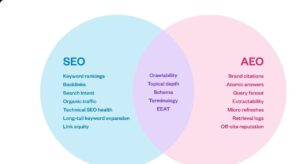
- What is the difference between SEO and AEO?
- How can I optimize content for Google SGE?
This increases your chance of appearing as an AI-generated reference.
2. Write “Answer-First” Paragraphs
Start every section with the shortest possible answer.
Example:
“Answer Engine Optimization (AEO) is the process of optimizing content for AI answer engines that provide instant responses.”
Then add supporting details.
3. Create Highly Structured Content
AI engines prefer structured formats because they are easier for LLMs to process.
Use the following elements:
- Bullets
- Numbered steps
- Clear headings
- Short paragraphs
- Bold keywords
4. Add Advanced Schema Markup
Use schema to help AI understand your page.
Recommended Schema Types
- FAQ
- How-To
- Breadcrumb
- Article
- Organization
- Person
- Product
This increases your chances of being quoted by AI tools.
5. Use Conversational Long-Tail Keywords
AI engines rely on natural language, not just exact-match keywords.
Examples
- “How will AI affect SEO in 2026?”
- “What is the best AEO strategy today?”
- “How to rank in ChatGPT Search?”
These types of keywords align with AI-driven search behavior.
6. Focus on Entity-Based Optimization
AI uses entities (people, places, and brands) instead of keywords.
Example
If your brand is connected to an industry or topic,
AI engines better recognize your authority.
7. Use Author Profiles & Expertise
Add author bios, credentials, and real experience to build trust.
8. Add Multimodal Content
AI engines process:
- Images
- Videos
- Infographics
- Charts
This increases your visibility in multimodal search results.
Future of AEO & AI Search (2026–2027 Predictions)
AI and search will continue changing rapidly.
Key Trends
- AI-generated answers will represent 70% of user queries
- Traditional organic clicks will reduce
- Content must be conversational to survive
- Voice search will merge with AI assistants
- Entity-based SEO will surpass keyword-based SEO
Conclusion
Answer Engine Optimization (AEO) and AI Search Ranking are now essential parts of digital marketing. To stay ahead, brands must shift from keyword stuffing to providing clear, structured, conversational answers that AI engines can easily extract. If you optimize now, you can dominate Google SGE, ChatGPT Search, Perplexity, and all major AI-driven search platforms.